Empowering Education in Puducherry
Learn how Parakh drives assessment reforms and board equivalence.
State Council of Educational Research and Training (SCERT)
(Directorate of School Education, Government of Puducherry)
Welcome to SCERT Puducherry
The apex body for school education, teacher training, and curriculum framework in the Union Territory of Puducherry. We are committed to nurturing future-ready citizens through innovative pedagogy, evidence-based assessment, and robust academic support.
Directives & Spotlight: Embracing the Vision of Hon’ble PM Narendra Modi
🌟 Shaping the Future of Classrooms: The PARAKH Initiative
Under the visionary leadership of Hon’ble Prime Minister Shri Narendra Modi, India’s educational landscape is undergoing a monumental paradigm shift. At SCERT Puducherry, we proudly embrace and champion the PARAKH (Performance Assessment, Review, and Analysis of Knowledge for Holistic Development) initiative—a cornerstone of the National Education Policy (NEP 2020).
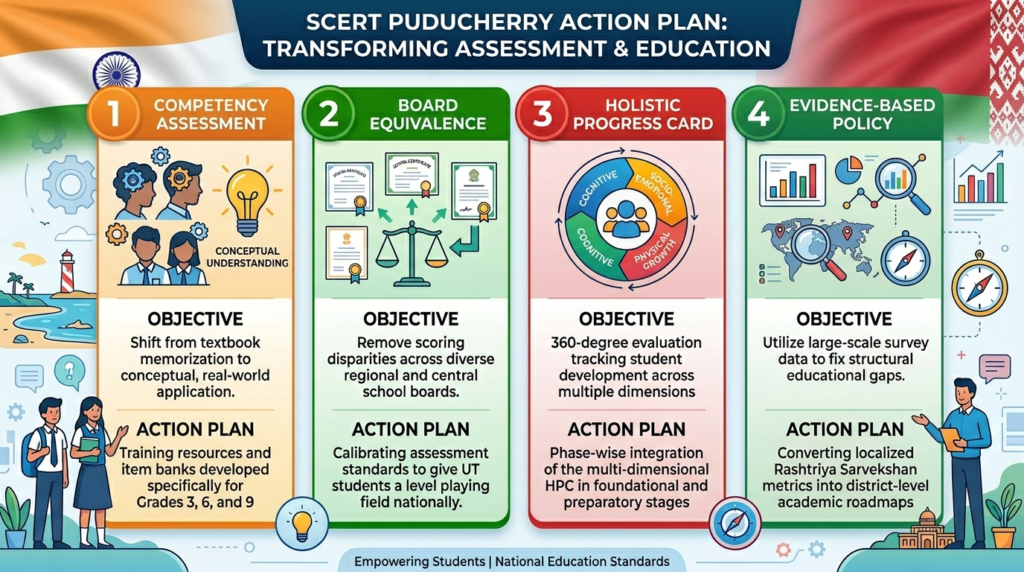
PARAKH is fundamentally transforming our schools by dismantling the age-old culture of rote memorization. Guided by the Prime Minister’s vision to prepare youth for real-world, 21st-century industry challenges, PARAKH shifts the focus toward competency-based learning, critical thinking, and logical reasoning.
Through the deployment of the Holistic Progress Card (HPC) and the data-driven insights from the PARAKH Rashtriya Sarvekshan, Puducherry is actively bridging learning gaps and creating an equitable evaluation standard that ensures no child is left behind.
Core Pillars of PARAKH Implementation in Puducherry
Key Administrative & Academic Links
- NEP 2020 Implementation Cell – Tracking milestones across the Union Territory.
- Teacher Capacity Building – Specialized workshops for competency-based item construction and evaluation templates.
- Puducherry Rashtriya Sarvekshan Report – Access state-specific data, analytical tools, and learning gap interventions.
- Digital Repository & Handbooks – Practical, localized instruction guides for classroom teachers and school heads.
📅 SCERT Puducherry CBA Training Roadmap & Phase Structure
1.Phase 1: Master Trainer Workshops (State Level):Foundational Alignment.
SCERT core academic faculties and selected key resource persons (KRPs) undergo benchmarking workshops. The focus is on translating PARAKH standards into regional language contexts (Tamil, Telugu, Malayalam, and French) across Puducherry, Karaikal, Mahe, and Yanam.
2.Phase 2: Question Bank & Item Construction:Targeting Grades 3, 6, and 9.
Cluster-level physical and hybrid training targeting language, mathematics, and science teachers. Educators learn how to draft assessment “items” that test conceptual clarity, logical elimination, and data interpretation instead of direct textbook recall.
3.Phase 3: Holistic Progress Card (HPC) Orientation:Foundational & Preparatory Schools.
Training sessions for Primary School Teachers (PSTs) and Headmasters on evaluating non-cognitive domains. Teachers learn to manage 360-degree self-assessment, peer-assessment, and descriptive socio-emotional tracking sheets.
4.Phase 4: Post-Sarvekshan Remedial Mapping:Data-Driven Action Plans.
Utilizing the local Rashtriya Sarvekshan performance data to train teachers in creating localized remedial worksheets. This phase bridges documented regional gaps in specific learning outcomes (LOs).
📌 Core Modules Covered Under the Training
| Target Cadre | Key Modules | Delivery Mode |
| Primary Teachers (Grades 1-5) | FLN (Foundational Literacy & Numeracy) mapping, play-based assessment, HPC structural tracking. | In-person at regional DIETs |
| Graduated/Middle Teachers (Grades 6-8) | Multi-disciplinary evaluation templates, real-world case study item-writing. | Hybrid (Online webinars + cluster meets) |
| Secondary & Lecturers (Grades 9-12) | Analytical question design, board evaluation equivalence calibration under PARAKH norms. | Focused state-level laboratory sessions |
📢 Official Notice for UT Educators: Individual school batch allocations, exact dates, and venue details (including regional DIET centers in Karaikal or Mahe) are periodically updated on the official tracking portals. Teachers are instructed to verify their nomination status through their respective school logins on the Puducherry School-GIS or DSE Circular portal.
The PARAKH Rashtriya Sarvekshan (which evolves and builds upon the foundational methodology of the erstwhile National Achievement Survey – NAS) is India’s premier national-level, large-scale achievement survey. Mandated by the National Education Policy (NEP 2020) and executed under the National Assessment Centre (PARAKH) and NCERT, it acts as a health check on the country’s school education ecosystem.
The framework is strictly structured across defined target classes, core subjects, and critical underlying evaluation parameters.
🏫 Target Classes & Core Subjects Evaluated
The assessment intentionally targets specific milestone milestones marking the end of the Foundational, Preparatory, and Middle stages of education. Testing time windows scale according to the grade complexity.
| Target Grade | Schooling Stage Aligned (NEP) | Core Subjects Assessed | Duration |
| Grade 3 | End of Foundational Stage | 1. Language 2. Mathematics 3. The World Around Us (TWAU) | 90 Minutes |
| Grade 6 | End of Preparatory Stage | 1. Language 2. Mathematics 3. The World Around Us (TWAU) / EVS | 90 Minutes |
| Grade 9 | End of Middle Stage | 1. Language 2. Mathematics 3. Science 4. Social Science | 120 Minutes |
Note: To ensure complete inclusivity across India’s diverse regional landscapes, the test booklets are administered in 23 mediums of instruction.
📊 Key Assessment Parameters
The framework evaluates the education system using a dual-layered parameter model: Student Competency Metrics (what the child knows) and Contextual Questionnaires (the external environment impacting how they learn).
1. Student Competency Metrics
Instead of checking memory retention, PARAKH measures higher-order intellectual capabilities:
- Conceptual Clarity: Can the student understand the fundamental “why” behind rules, math sets, and scientific formulas?
- Application-Based Analysis: The capacity to pick out central ideas from long text pieces, apply arithmetic to financial scenarios (like managing balances under ₹100 or estimating area/volume), and map out environmental patterns.
- Critical Thinking & Reasoning: Testing logic, hypothesis evaluation, and multi-step deduction, particularly tracking the shift from basic memory to predictive reasoning in middle school math and science.
2. Contextual & Systemic Parameters
PARAKH recognizes that student performance doesn’t happen in a vacuum. It tracks performance data by matching results against a series of demographic and administrative questionnaires:
- Socio-Demographic Vectors: Comparative filters checking performance variations across Gender, School Location (Urban vs. Rural), and Social Groups (General, OBC, SC, ST).
- Institutional Frameworks: Dissecting achievement gaps based on School Management types (State Government, Government-Aided, Central Government, and Private Recognized Schools).
- Environmental Factors: Gathering structured responses from Teachers and School Heads via specialized questionnaires assessing teacher capacity preparedness, infrastructure facilities, and pedagogical methodologies used in daily operations.
The Structural Objective: The ultimate parameter of the Rashtriya Sarvekshan is not to rank individual students, but to compile district- and state-level data metrics. This data is used to implement targeted remedies like the Holistic Progress Card (HPC), plug foundational literacy/numeracy gaps, and help bodies like SCERT craft data-backed teacher training programs.
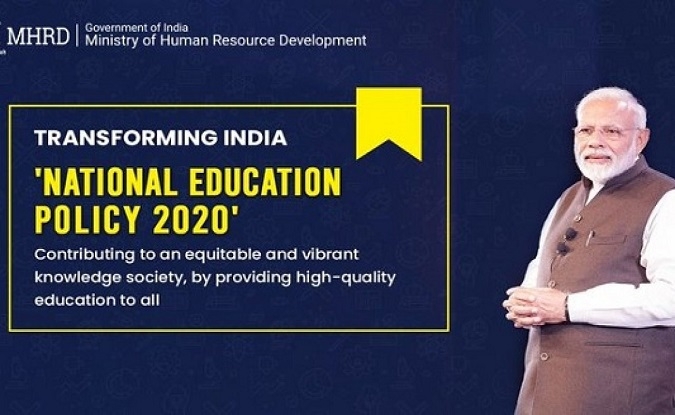
Ensuring smooth board equivalence aligned with NEP 2020 reforms.

Tracking evaluation progress in Puducherry, Karaikal, Mahe, and Yanam.
Highlighting the core pillars driving competency-based assessment.